
Introduction
Blockchain technology has revolutionized digital finance, decentralized applications, and Web3 infrastructure. However, as adoption of the Ethereum network has grown, scalability challenges such as high gas fees, slower transaction speeds, and network congestion have become major obstacles for developers and businesses.
This is where Arbitrum blockchain development comes into play.
Arbitrum is a powerful Ethereum Layer-2 scaling solution designed to improve the efficiency of decentralized applications (dApps) while maintaining the security of the Ethereum mainnet. By using advanced Optimistic Rollup technology, Arbitrum significantly reduces transaction costs and increases throughput without sacrificing decentralization.
For developers building the next generation of DeFi platforms, NFT marketplaces, gaming ecosystems, and Web3 applications, Arbitrum provides a highly scalable and developer-friendly environment.
In this guide, we will explore everything you need to know about Arbitrum development, including its architecture, features, development tools, and step-by-step instructions for building scalable Ethereum dApps.
What is Arbitrum?
Arbitrum is an Ethereum Layer-2 scaling solution developed to improve the performance and efficiency of Ethereum-based applications. It works by processing transactions off-chain while relying on the Ethereum mainnet for final settlement and security.
The core technology behind Arbitrum is Optimistic Rollups, which bundle multiple transactions together and submit them to Ethereum as a single transaction. This approach significantly reduces gas costs and increases network throughput.
Instead of executing every transaction on the Ethereum mainnet, Arbitrum processes transactions on its Layer-2 network and periodically posts compressed transaction data to Ethereum.
Key aspects of the Arbitrum network include:
- Off-chain transaction processing
- Ethereum-level security
- Lower gas fees
- Faster transaction confirmation
Because Arbitrum is fully compatible with Ethereum’s development environment, developers can deploy existing Solidity smart contracts without major modifications.
This compatibility makes Arbitrum one of the most attractive scaling solutions for Ethereum developers.
How Arbitrum Scales Ethereum
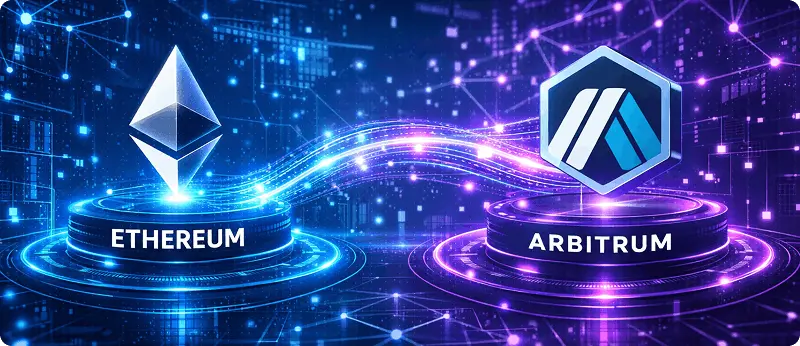
One of the biggest challenges with Ethereum is scalability. As network activity increases, gas fees rise and transaction speeds decrease.
Arbitrum solves this problem using a Layer-2 architecture built around Optimistic Rollups.
Here’s how the scaling process works:
Transaction Batching
Instead of processing transactions individually on Ethereum, Arbitrum batches hundreds or thousands of transactions together and processes them off-chain.
These batches are then submitted to the Ethereum mainnet as compressed data, significantly reducing the cost per transaction.
Rollup Technology
Rollups aggregate multiple transactions into a single proof that is stored on Ethereum. This drastically reduces the computational workload on the Ethereum network.
Fraud Proofs
Arbitrum assumes transactions are valid by default (hence the term “optimistic”). However, if someone suspects fraud, they can submit a challenge.
This fraud-proof mechanism ensures that malicious transactions can be detected and reversed while maintaining security.
Reduced Gas Costs
Because only summarized transaction data is stored on Ethereum, users pay significantly lower gas fees compared to the Ethereum mainnet.
As a result, developers can build applications that handle high transaction volumes at much lower costs.
Key Features of Arbitrum
Arbitrum offers several powerful features that make it a popular platform for building scalable decentralized applications on top of Ethereum.
1. High Scalability
Arbitrum significantly increases transaction throughput by processing transactions off-chain using rollup technology. This allows the network to handle a much larger number of transactions compared to Ethereum mainnet.
2. Low Transaction Fees
One of the biggest advantages of Arbitrum is reduced gas fees. By batching transactions and submitting them to Ethereum in compressed form, users pay much lower costs for transactions. Blockchain Development Frameworks in 2026
3. Ethereum Compatibility
Arbitrum is fully compatible with the Ethereum Virtual Machine (EVM). Developers can easily deploy existing Solidity smart contracts and use familiar tools without major changes.
4. Strong Security
Although transactions are processed on Layer-2, Arbitrum inherits the security of the Ethereum network. All transaction data is ultimately secured on Ethereum, ensuring a high level of trust and decentralization.
5. Faster Transactions
Arbitrum provides faster transaction confirmations compared to Ethereum mainnet, improving the user experience for decentralized applications.
6. Developer-Friendly Ecosystem
Developers can build applications on Arbitrum using popular tools like Hardhat, Foundry, Web3.js, and Ethers.js, making the development process smooth and efficient.
Arbitrum Development Tools
Developers building on Arbitrum can use a wide range of tools and frameworks that are commonly used in the Ethereum ecosystem.
Here are some essential tools for Arbitrum development.
1. Hardhat
Hardhat is one of the most popular development environments for Ethereum smart contracts.
It provides features such as:
- smart contract compilation
- automated testing
- debugging tools
- deployment scripts
Hardhat works seamlessly with the Arbitrum network.
2. Foundry
Foundry is a modern toolkit for smart contract development.
It allows developers to:
- test contracts quickly
- run fuzz testing
- deploy smart contracts efficiently
Foundry is becoming increasingly popular among Web3 developers.
3. Arbitrum SDK
The Arbitrum Software Development Kit provides libraries that make it easier to interact with the Arbitrum network.
Developers can use it to:
- bridge assets between Ethereum and Arbitrum
- send transactions
- monitor Layer-2 activities
4. Web3.js and Ethers.js
These JavaScript libraries allow front-end applications to interact with smart contracts deployed on Arbitrum.
They enable functions such as:
- wallet integration
- contract calls
- transaction signing
These libraries are essential for building full-stack Web3 applications.
How to Build a dApp on Arbitrum
Developing a decentralized application on Arbitrum follows a process similar to Ethereum development.
Here is a simplified step-by-step guide.
Step 1: Set Up the Development Environment
First, install the necessary development tools:
- Node.js
- Hardhat or Foundry
- MetaMask wallet
You will also need to configure the Arbitrum network in your development environment.
Step 2: Write the Smart Contract
Next, create a smart contract using Solidity.
Example contract:
pragma solidity ^0.8.0;

contract SimpleStorage {
    uint256 public data;

    function setData(uint256 _data) public {
        data = _data;
    }
}
This contract stores a simple integer value.
Step 3: Compile and Test the Contract
Using Hardhat or Foundry, compile your contract and run tests to ensure it behaves correctly.
Testing is critical to prevent vulnerabilities and ensure security.
Step 4: Deploy on the Arbitrum Network
After testing, deploy the contract to the Arbitrum network using deployment scripts.
Developers typically deploy to:
- Arbitrum Goerli testnet (for testing)
- Arbitrum One mainnet (for production)
Step 5: Integrate Frontend with Web3
Finally, connect your frontend application to the deployed smart contract.
Using libraries like Ethers.js, you can interact with the contract from your web interface.
Users will then be able to:
- send transactions
- read blockchain data
- interact with decentralized features
Arbitrum Use Cases
Arbitrum has become one of the most widely used Layer-2 ecosystems for building scalable decentralized applications. With low gas fees, high transaction speed, and full EVM compatibility, it enables developers and businesses to build efficient Web3 solutions.
1. DeFi Platforms (Decentralized Finance)
One of the biggest use cases of Arbitrum is DeFi applications. Platforms such as decentralized exchanges, lending protocols, and yield farming systems require fast and low-cost transactions. By processing transactions on Layer-2 while maintaining the security of Ethereum, Arbitrum makes DeFi operations faster and more affordable.
2. NFT Marketplaces
NFT platforms benefit greatly from Arbitrum because minting and trading NFTs on the Ethereum mainnet can be expensive. With lower fees and faster transactions, creators and collectors can interact with NFT marketplaces more efficiently.
3. Blockchain Gaming
Blockchain games require high transaction throughput for in-game actions like asset trading and minting NFTs. Arbitrum allows developers to build scalable gaming ecosystems where players can trade items, earn rewards, and manage in-game assets without high transaction costs.
4. Web3 Social Platforms
Decentralized social networks often require frequent micro-transactions such as posting, tipping, or interacting with content. Arbitrum enables developers to create Web3 social platforms with lower fees, improving accessibility and user experience.
5. DAO Infrastructure
Decentralized Autonomous Organizations (DAOs) rely on blockchain for governance and treasury management. Arbitrum reduces the cost of governance transactions, making activities such as voting, proposal creation, and community reward distribution more efficient.
6. Enterprise Blockchain Solutions
Businesses are increasingly exploring Arbitrum for enterprise blockchain applications, including supply chain tracking, digital identity systems, tokenized assets, and decentralized financial infrastructure. Its scalability and Ethereum-level security make it attractive for enterprise adoption.
7. Cross-Chain and Layer-3 Ecosystems
Arbitrum is also expanding with innovations like Layer-3 networks and cross-chain interoperability, allowing developers to build specialized blockchain ecosystems for gaming, DeFi, and enterprise solutions while maintaining Ethereum security
Arbitrum vs Other Layer-2 Solutions
Several Layer-2 solutions exist to address Ethereum scalability. The most popular alternatives include Optimism, Polygon, and zkSync.
Arbitrum vs Optimism
Both Arbitrum and Optimism use Optimistic Rollups.
However, Arbitrum generally provides:
- higher throughput
- better developer tooling
- strong ecosystem growth
Arbitrum vs Polygon
Polygon offers multiple scaling solutions, including sidechains and zk-rollups.
However, Arbitrum benefits from stronger Ethereum security because it relies directly on rollup technology rather than sidechains.
Arbitrum vs zkSync
zkSync uses zero-knowledge rollups, which offer faster finality but can be more complex for developers.
Arbitrum remains easier to adopt due to its strong compatibility with Ethereum tools.
Future of Arbitrum
The future of Arbitrum looks extremely promising.
As demand for scalable blockchain infrastructure continues to grow, Layer-2 solutions are becoming essential for the Web3 ecosystem.
Several trends are driving Arbitrum’s growth:
- expanding DeFi ecosystem
- enterprise blockchain adoption
- improved developer tooling
- new Layer-3 networks built on Arbitrum
Innovations such as Arbitrum Orbit, which allows developers to build customizable Layer-3 chains, are expected to further expand the ecosystem.
These advancements position Arbitrum as a major player in the future of scalable blockchain technology.
Conclusion
Arbitrum has emerged as one of the most powerful solutions for solving Ethereum’s scalability challenges.
By leveraging Optimistic Rollups, the platform significantly reduces transaction fees while increasing throughput while maintaining the security of Ethereum.
For developers building decentralized applications, Arbitrum provides a familiar development environment with powerful scaling capabilities. At Qonsult Blockchain Solution, developers and blockchain experts leverage Arbitrum to build scalable, secure, and high-performance Web3 solutions.
From DeFi platforms and NFT marketplaces to gaming ecosystems and Web3 applications, Arbitrum enables developers to create high-performance, cost-efficient blockchain solutions.
As the Web3 ecosystem continues to expand, Arbitrum will play a crucial role in shaping the future of scalable decentralized infrastructure, and companies like Qonsult are helping businesses adopt this technology to build the next generation of decentralized applications
FAQs
Arbitrum is an Ethereum Layer-2 scaling solution that improves transaction speed and reduces gas fees using optimistic rollups while maintaining Ethereum security.
Developers use Arbitrum to build scalable decentralized applications with lower gas fees, faster transactions, and full compatibility with Ethereum smart contracts.
Arbitrum processes transactions off-chain and submits compressed data to Ethereum, which significantly reduces gas costs.
Yes, Arbitrum is fully compatible with Ethereum Virtual Machine (EVM), allowing developers to deploy Solidity smart contracts without major changes.
Developers can build DeFi platforms, NFT marketplaces, Web3 applications, gaming platforms, and DAO infrastructure on the Arbitrum network.